
Inpixon RTLS
Real-Time Location Systems
Explore Inpixon's industry-leading RTLS products or read on to learn more about these components and how real-time location systems work
Request Consultation RTLS PlatformWhat is a Real-Time Location System?
Real-time location systems (RTLS) enable you to digitally track the real-time location and movements of physical things throughout large facilities. RTLS primarily leverage radio-frequency (RF) technologies like UWB, BLE and Chirp, as well as wireless devices, such as tracking tags and smartphones, alongside other integrated components, to continuously determine the position of people and objects in areas GPS is not able to reach. This delivers actionable location data that can be used to visualize the location of key personnel, assets, vital equipment and more on a live digital twin or integrated into automated workflows and systems such as IoT-enabled safety applications, asset & supply chain management solutions and more.
Real-time location systems are a key foundation of digital innovation, digital twin technology, IoT, and Industry 4.0, and help organizations in manufacturing, warehouses, and more transform physical operations by improving safety, boosting efficiency and driving business results.
How Does a Real-Time Location System Work?

The specifics vary from system to system, but every RTLS uses a network of connected hardware and software to track the location of people and objects within a defined area. Most rely on RF technologies like UWB, Bluetooth, Wi-Fi, and chirp, for wireless communication between transmitting, receiving, and transceiving devices. A tag transmits data-encoded RF signals, or location "blinks," at continuous intervals.
Fixed receivers (anchors or readers) mounted throughout the facility pick up those signals and forward the location data, along with any accompanying IoT data such as temperature or battery, to a location engine, which calculates each device's position. The technique used to determine location differs by technology: distance-based methods like time difference of arrival (TDoA) are generally more accurate than Received Signal Strength Indicator (RSSI).
Because an enterprise deployment can involve thousands of tracked assets, the location engine processes all of them concurrently in real time. That position data can then be visualized on a live digital twin of the facility or fed directly into enterprise systems like ERP and MES to power a range of location-aware use cases.
RTLS components can also enable ranging applications, where two transceiver tags communicate directly to measure the distance between them — the basis for proximity-based use cases such as worker-to-vehicle collision avoidance.
Did You Know?
What Components are in a RTLS?
The components used in each individual RTLS, as well as the RF standards and characteristics of those components can vary. Factors such as performance requirements, like accuracy, latency, range, throughput, as well as the complexity of a deployment and desired use cases dictates what type of RTLS components and specific RF technology will best address your needs. However, most location-tracking solutions share these core components – anchors, tags/transmitting devices and a location engine. In addition to those core components there are also modular RTLS components that can be integrated into IoT devices and applications to enable customized RTLS-enabled devices and solutions that meet the needs of specialized use cases and unique end-user requirements.
Anchors
RTLS anchors are readers that deploy in fixed positions to detect and locate signals from transmitting RTLS tags and devices. To accurately determine a tag’s real-time location, each anchor within its communication range will read and often timestamp the received signals, and then exchange this information with the location engine to calculate the tag’s position. In addition to being able to receive communication, certain RTLS anchors can also transmit data to other devices, enabling you to do things like wireless configuration, firmware flashing, and sending data to a tag to manipulate actuators like LEDs or even machines, allowing for more versatile applications.Tags, Badges, Beacons...
RTLS tags are wireless devices that are equipped to people, assets, equipment, inventory or mobile objects to help determine their location. RTLS tags send data encoded signals at continuous intervals to RTLS readers that then forward this information to the location engine to determine its position. Tags come in all shapes and sizes, such as in form factors like asset tags, beacons, ID badges and more. Certain tags come equipped with additional embedded sensors and long-lasting internal batteries that allow for more flexible applications.Location Engine (Software)
A location engine is the RTLS software that processes the received location and IoT data from the RTLS hardware. Different location engines leverage different techniques to calculate the position of a tracked person or objects, delivering actionable intelligence that can be integrated into IoT applications and systems like Enterprise Resource Planning (ERP) and Manufacturing Execution Systems (MES).
RTLS Modules
RTLS modules are pre-built transceivers that can be integrated into custom RTLS anchors, tags and connected devices. This helps organizations reduce development complexity and the time to solution required in building their own tailored RTLS-enabled devices. For example, an organization can easily integrate a module into their own proprietary tag design, activating real-time location tracking capabilities with hardware that meets their unique needs, functional and compliance requirements.
RTLS Transceiver Chips
RTLS transceiver chips are essentially the brain of an RTLS-enabled device. Inside RTLS hardware they power the wireless communication that makes real-time locationing possible. The chips serve as the starting point for development of custom RTLS devices. From them, organizations can design their own tailored RTLS-enabled device, such as a location tracking tag, allowing them to develop and build RTLS hardware with complete flexibility and control to create proprietary devices that meet their exact needs, functional and compliance requirements.
IoT Sensors
Smart IoT sensors can be added into RTLS devices and applications to extend RTLS-enabled solutions even further. These sensors deliver additional IoT data that when paired with the derived location data, enriches the intelligence a deployed RTLS uncovers. This includes sensors built directly into RTLS devices, such as 3D accelerometers, temperature sensors, or battery readers in a tracking tag, as well as auxiliary IoT sensors that monitor conditions such as CO2 concentration, temperature, humidity, sound and more.
How Accurate are Real-Time Location Systems?
The accuracy of real-time location systems differ greatly depending on the underlying RF technology and positioning techniques each individual system uses. For applications that require a high degree of precision, a standard like UWB can deliver high location accuracy, +/- 40 cm, through time-of-arrival-based position calculations.
Other technologies that also leverage distance-based position calculations, such as chirp (CSS) can deliver high accuracy between 1-2 meters. UWB and chirp also perform well against RF interference to help ensure accurate results, while other technologies are more vulnerable to these impacts, degrading positioning results. Other traditional positioning technologies such as Wi-Fi and Bluetooth, generally deliver less accurate results between 1-10 meters. This is because most Wi-Fi/Bluetooth-enabled applications rely on Received Signal Strength Indicator (RSSI)-based multilateration, which is less precise than technologies like UWB. In certain applications, precision isn’t a requirement and meter-level accuracy is sufficient. However, new advances in Wi-Fi and Bluetooth technologies are beginning to allow for more precise locationing by implementing time-of-flight (ToF) and angle of arrival (AoA) calculations into their architecture.
The level of accuracy required for a RTLS varies based on individual customers’ needs and desired use cases – some users require high accuracy to instantly pinpoint a piece of critical equipment in a large industrial environment, while others may only need to know the general location of an asset. Accuracy requirements can also be determined based on the number of deployed RTLS reference points.
What is the Range of a Real-Time Location System?
The range of real-time location systems greatly differ depending on the underlying RF technology and type of deployments. Chirp and Wi-Fi-based systems both operate at 2.4 GHz and can deliver long-range accessibility over values of 300 meters. Chirp excels in this regard, as it enables long-range applications, with less required anchors, and functions both in and outdoors with no spectrum license required.
Other technologies like UWB and BLE are much more limited in the range they can provide. The range required for a RTLS also strongly varies based on the deployment environment and individual customers’ needs and desired use cases. Some users require a high degree of range to track assets like containers, pallets, equipment, or personnel across large facilities, between indoor and outdoor areas, or in hard-to-reach places likes mines, while others may be more concerned with ensuring a high degree of accuracy within a more confined area like the exact location of a part as it moves through an assembly line.
RTLS Technologies
Ultra-Wideband
UWB RTLS delivers centimeter-level accuracy with extremely low latency, making it the choice for precisely locating high-value parts, tools, and work-in-progress on the production line. Its precision comes from distance-based time-of-flight measurement; it works best over shorter ranges and is power-efficient enough for tags that run for years on a coin-cell battery.
Chirp Spread Spectrum (CSS)
CSS RTLS combines long range, seamless indoor-to-outdoor coverage, and low power with 1–2 m accuracy — ideal for large plants and yards where running dense infrastructure is impractical. It excels in industrial-grade deployments, and Inpixon is the market leader in CSS, with long-range tags, anchors, and its proprietary nanoLOC location chip that powers chirp solutions worldwide.
Wi-Fi
Wi-Fi RTLS leverages a facility's existing access points and infrastructure, making it an easy, low-cost way to add location tracking of tags and devices across indoor spaces. It typically relies on Received Signal Strength Indicator (RSSI) methods, with more advanced techniques available for higher accuracy.
Bluetooth Low Energy
BLE RTLS is one of the most popular RTLS technologies thanks to its low-power, low-cost, easy-to-deploy hardware. BLE sensors or beacons detect and locate transmitting tags and devices throughout a facility, feeding location data into the platform to power a wide range of tracking use cases.
RFID
RFID RTLS comes in two forms. Passive RFID uses battery-less tags powered by nearby readers — a low-cost option for short-range identification rather than true location. Active RFID adds an on-tag battery for longer range at higher cost. Both are prone to interference from physical obstructions.
Infrared (IR)
IR is a niche option that uses the same optical signaling as a TV remote. It requires line of sight between tag and receiver and provides only room-level accuracy; tags are cheap, but the required infrastructure rarely already exists.
Ultrasound
Ultrasound is a sonic alternative to RF and optical locating. It can pinpoint objects but is blocked by walls and other barriers, limiting it to room-level accuracy.
* With optimal conditions and deployment
Indoor Positioning Techniques
.png?width=297&height=238&name=image%20(5).png)
Time-Difference of Arrival
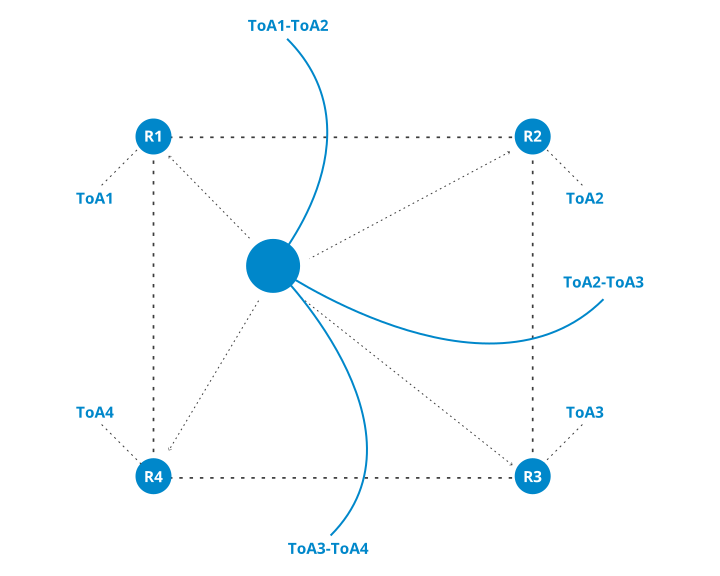
TDoA utilizes UWB or Chirp anchors that are deployed in a fixed position throughout an indoor space. These anchors then detect and locate a transmitting device, such as a tracking tag. To work properly, the fixed anchors need to be accurately synchronized to run on the same clock. The tag, or other device, will transmit signals in regular intervals. These signals will be received by any anchors in the communication range and time-stamped by the anchors. All the time-stamped data is then sent to the central IPS or RTLS.
The location engine will analyze each anchor’s data and the differences in arrival times to each anchor and use multilateration to calculate the tag’s coordinates. Those coordinates can be used to visualize the location of the device on an indoor map of your space or leveraged for other uses depending on the specific application.
Two Way Ranging (TWR)
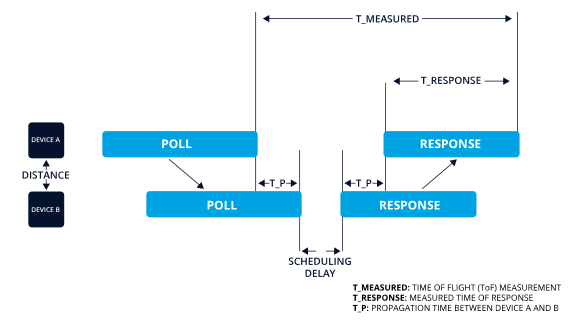
While in TDoA multiple fixed anchors work together to determine the location of a mobile object, Two-Way Ranging primarily uses two-way communication between two devices, such as smartphones or vehicle tags, to sense the distance between them. This means that an autonomous collision awareness system can be created without any additional infrastructure. With TWR, when a device is in close proximity to another, the two devices will start ranging with each other to determine their distance, even as they communicate. The time it takes a signal to travel between them is then multiplied by the speed of light and used to determine their relative positions, frequently, to enable location-aware communication.
Angle of Arrival (AoA)
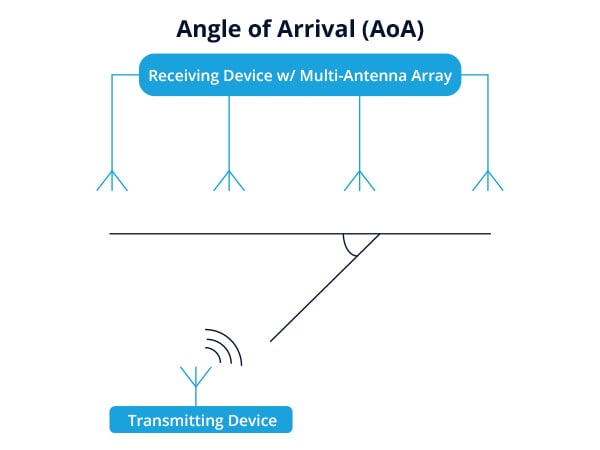
AoA is an advanced positioning method which can deliver with enhanced accuracy compared to more traditional techniques like fingerprinting and RSSI. This is possible due to Multiple Input Multiple Output (MIMO) interfaces. To be able to find direction, a mobile asset, such as a tag or beacon with a single antenna, transmits to a fixed RTLS sensor with a multi-antenna array. The phase shift of the multiple antennas, as a result of receiving the signal, is measured and calculated to determine the angle of the transmitting mobile device and create an area of certainty of the object to be located.
One advantage of an AoA approach is that it reduces the number of necessary reference points. Instead of a minimum of three sensors as required for any multilateration approach, you only need two to create an unambiguous determination of position. Additional reference points add to the accuracy and reliability of the calculated positions. While indoor positioning via AoA is more accurate than signal strength approaches, solutions that leverage this technique are only just entering the market.
Received Signal Strength Indicator (RSSI)
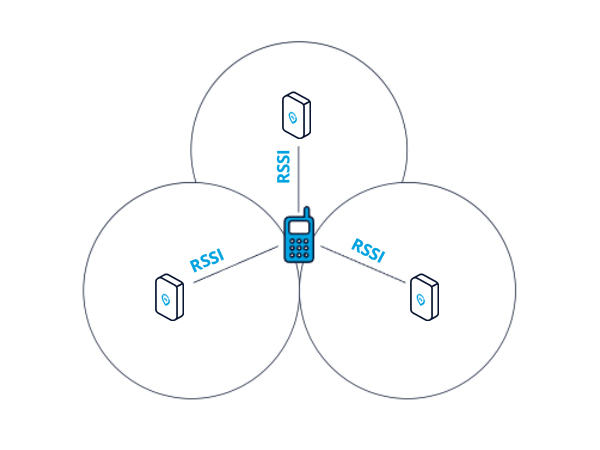
In RSSI-based applications, multiple existing RTLS sensors deployed in a fixed position will detect transmitting devices and the received signal strength of the signal from the device. This location data collected by the sensors is sent to the location engine. The location engine analyzes the data and uses multilateration algorithms to estimate the location of transmitting devices. Alternatively, the signal strength of nearby sensors relative to a wireless device can be used to determine the device’s location.
Using an RSSI-based method with multilateration is the most easily activated and low-cost option for indoor positioning. However, it doesn't deliver a high degree of positional accuracy because it is subject to signal attenuation, absorption, reflection and interference.

Enhance Safety & Prevent Costly Incidents
Create real-time visibility to help identify, prevent and respond to threats to worker safety. Improve compliance efforts and power use cases like collision avoidance, evacuations, worker search and rescue, contact tracing and more.
Improve Efficiency & Streamline Workflows
Leverage location to help boost productivity and connect siloed processes. Instantly track assets and personnel, identify potential bottlenecks, poor resource utilization and more.
Drive Business Results
Harness location data and context to make smarter more informed decisions, improve resource allocation, reduce costs, boost production speed and quality, as well as asset performance and more.